With the development of the company's UAV business, the demand for UAV exports has been growing increasingly robust. In this context, closely following the relevant policies and measures issued by the government has become particularly crucial. Therefore, today we are sharing this article titled Overview of UAV Export Conditions and Restrictions.
The export of unmanned aerial vehicles (UAVs) is subject to strict regulation by national and international laws and regulations, and cannot be conducted freely.
In simple terms, whether a UAV can be exported and which countries it can be exported to depend primarily on the following core factors:
(1) 🎮 Civilian Consumer-Grade (Aerial Photography, Entertainment)
- Typical Features: Portable, affordable price point
- Export Difficulty: ⭐⭐ Relatively easy
- Regulation Rationale: Low technical specifications, minimal risk
(2) 🏭 Civilian Industrial-Grade (Surveying and Mapping, Agriculture)
- Typical Features: Industry-specific application UAVs
- Export Difficulty: ⭐⭐⭐⭐ Strictly regulated
- Regulation Rationale: Exceeding limits on payload/endurance = dual-use items (military and civilian applicability)
(3) 💣 Military-Grade
- Typical Features: Reconnaissance and strike integrated UAVs
- Export Difficulty: ⭐⭐⭐⭐⭐ Nearly prohibited
- Regulation Rationale: Pure weapon systems; special approval is extremely difficult to obtain
Key Red Line: Once a UAV meets the criteria of endurance ≥ 1 hour + service ceiling ≥ 15,420 meters + qualified payload capacity — congratulations, it has successfully been added to the "dual-use items" blacklist!
🇨🇳 China:
- Regulated under the Catalogue of Dual-Use Items and Technologies Subject to Import and Export License Administration jointly issued by the Ministry of Commerce and the General Administration of Customs.
- Listed products (industry-specific UAVs) must apply for a Dual-Use Items Export License.
- Strict review of end-users and end-uses: Prohibited for use in weapons of mass destruction (WMD) proliferation or terrorist activities.
🇺🇸 United States:
- Regulated under the Export Administration Regulations (EAR) administered by the Bureau of Industry and Security (BIS) of the Department of Commerce.
- Tiered management via the Commerce Control List (CCL); essentially closed to China/Russia/Iran.
🌐 International MTCR Regime: An Invisible CeilingAlthough China is not a member, it has repeatedly stated that it will reference the regime’s guidelines and parameters for export control.Core Red Line: UAVs with a payload of 500kg+ and a range of over 300km are generally subject to global embargo.
Even if a UAV is inherently civilian, export applications will be extremely difficult to approve if the purchaser is a military force, sensitive government department, or if there is evidence that the UAV may be used for military purposes, as a delivery vehicle for WMDs, or in terrorist activities.
——————————————————
If you intend to export UAVs, you typically need to:
- Self-Assessment: Test parameters and classify the UAV (refer to the above categories)
- Regulatory Research: Visit the official website of your country’s commerce ministry to download the latest control list
- License Application: Truthfully complete the application form (including UAV parameters, buyer background, and end-use certification)
- Customs Clearance: Proceed with the valid license and cooperate with inspection procedures
🚨 Customs Declaration Document Checklist (Recommended to Print and Post)✅ Quantity/Weight✅ Product Certificates (Non-dual-use Item Certification)✅ Cargo Dimensions/Parameters/Images✅ Cargo Value✅ End-User-Stamped "End-Use Statement" (Most Critical!)
In summary, the export of consumer-grade UAVs is relatively straightforward, but the export of industrial-grade and military-grade UAVs is a highly sensitive and complex field. It is imperative to strictly comply with domestic and international laws and regulations; otherwise, severe legal consequences (including heavy fines, criminal penalties, and trade bans) may ensue.
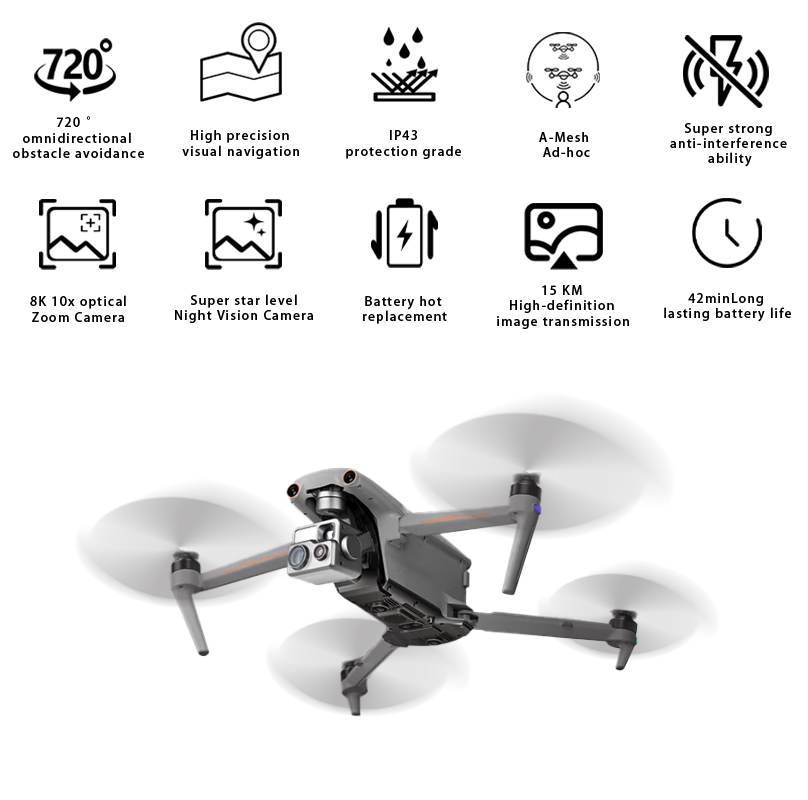
The EVO Max 4T is a high-performance UAV launched by Autel Robotics. Positioned for high-end industrial applications, it also meets top-tier professional aerial photography needs. Its core advantages lie in its multi-camera configuration (the "4" in 4T) and powerful thermal imaging capabilities (the "T" in 4T). Boasting
-
Flagship 4-Camera Gimbal System – the origin of its name "4T". It integrates four distinct sensors on a single gimbal, enabling seamless switching:
- Wide-Angle Camera: 50MP, 1/1.28-inch CMOS, designed for high-resolution photography and video recording.
- Telephoto Camera: 64MP, supporting up to 16x hybrid zoom, ideal for long-distance observation.
- Ultra-Wide-Angle Camera: 8MP, offering an expansive field of view.
- Thermal Imaging Camera: 1280×1024 resolution with laser rangefinding capability, suitable for temperature measurement, night vision, search and rescue, inspections, and other scenarios.
-
Powerful Flight and Image Transmission Performance
- Transmission Distance: Up to 20km, with exceptional stability.
- Flight Time: Maximum endurance of approximately 42 minutes, meeting the needs of most operational tasks.
- Wind Resistance: Withstands wind speeds of up to 12m/s, ensuring strong stability.
- Protection Rating: IP43 dust and water resistance, allowing flight in light rain.
-
Intelligent Functions and AI Recognition
- Equipped with a high-performance AI chip, supporting automatic recognition and tracking of multiple targets (e.g., vehicles, ships, personnel).
- Features advanced functions such as intelligent tracking and route planning, significantly enhancing operational efficiency.
-
Key Application ScenariosThanks to its versatility and robust performance, the EVO Max 4T is widely used in:
- Public Security: Search and rescue, law enforcement, emergency response, and fire rescue (thermal imaging function is crucial here).
- Infrastructure Inspection: Inspections of power lines, oil pipelines, bridges, and buildings – especially thermal imaging that detects overheating fault points.
- Surveying and Mapping: 2D and 3D modeling via high-precision cameras.
- Professional Film and Television Production: Delivering high-quality aerial footage for movies, documentaries, and other productions.